
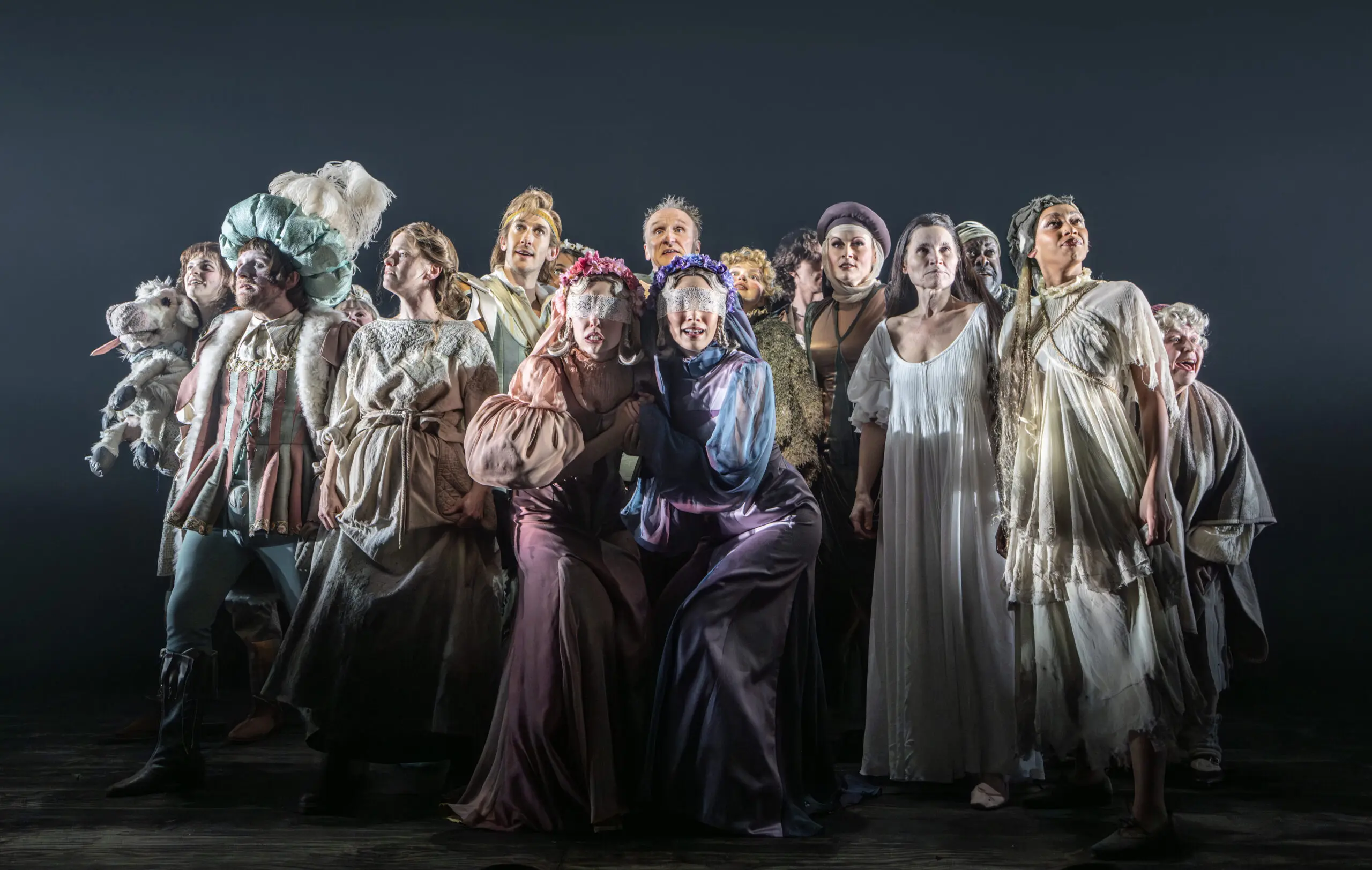
Kate Fleetwood on building her Witch for the West End production of Into the Woods, surviving a long theatre run and forging an acting career without drama school.
Even with Tony and Olivier nominations to her name, Kate Fleetwood isn’t immune to the uncertainty of an actor’s life. Midway through an acclaimed West End run as the Witch in Jordan Fein’s Into the Woods, she still doesn’t know what January holds.
Having built an enviable stage and screen career without formal drama school training – spending 15 years cleaning and waitressing along the way – she understands stamina better than most. We caught up with Kate to discuss Sondheim, vocal preservation, and surviving the realities of eight shows a week on stage.

Kate Fleetwood. Headshot by Johan Persson
Hi Kate. How’s the run going at the Noël Coward Theatre?
Good! It’s always a challenge moving a show into a new space because the whole topography shifts and your muscle memory gets challenged. Your spatial awareness has to shift onto a different plane and what was in your body suddenly feels completely different. You have to recalibrate. I think we’re there now, but it took a while.
It’s lovely to be in one of those beautiful jewel-box playhouses, though The Bridge was strangely intimate, too. Here, the audience is sort of up on top of you, so I have to look up in a different way. Luckily, I’m in the woods, so I’ve got good reason to.
How did you adapt your performance between the two theatre spaces?
You’re calibrating every night. I’m sure every actor reading this will understand: you’re never in the passenger seat; you’re always managing a performance. I was still doing it on the final night at The Bridge – always tinkering, hopefully never at the expense of the other performers. I’m connected, I’m listening, but I’m always looking for something that lands more profoundly. If it feels worth keeping, I’ll hold on to it the next night and explore it a bit.
It all happens very quickly, neurologically. You’re trying to be in flow 80% of the time and managing the other 20%. You’re always aware, but trying not to be aware.
What made you want to reprise the role?
I wasn’t finished with it. I wasn’t finished with the psychology, nor with what she’s saying: stop blaming each other and sort it out, because the apocalypse is coming. That seems more prescient than ever.
While our politics and our emotional landscape are so divided, any chance to share a live moment – performers, musicians, crew, stage management and audience – matters. So I wanted to keep drilling into that message with new performers and new audiences. A West End audience is different from a Bridge audience, which is different again from the Globe, Hampstead or the Fringe. I’ve worked in so many spaces and I always want to share the work with as many kinds of audiences as possible.
Why do you think the production connects so strongly with audiences?
It grabs people by the short and curlies when they least expect it. The first half is frantic and farcical and the storytelling is familiar: the archetypes, the fairy-tale characters. It’s funny and charming, so people settle in. Then the second half becomes something much more profound and people are caught off guard by how moved they are and by how it makes them feel about their own lives. It seems benign, but actually it’s incredibly knotty and that plumbs into something we all feel when we’re least expecting it. I think the benign start makes people feel comforted but we all know, deep down, there are issues we need to face.
How did you approach charting your character’s journey?
With a show this well known, the role is iconic and you’re aware of the very living memory of amazing performers who’ve come before. I’d always known it well and I’d watched the film a million times with my children. But I decided to watch the original production again on YouTube because sometimes it’s good to watch the story being told to find out what purpose the character serves for the audience. Where does she sit in the storytelling? What is her role in moving the story on?
You can read the script and score a million times and glean so much. But watching it tells you: there’s a beat that really matters, there’s a gear change in tone, this bit needs to move quickly. However I end up interpreting it and whatever rehearsals reveal, those are the tent pegs I have to land. Then I stop watching, because you don’t want it to interfere with your own response to the material.
After that, it was a process of talking to Jordan [Fein] (director) and Tom [Scutt] (designer), our visionary director about his own response to the character. I was lucky enough to go to Tom’s workshop, where they showed me the whole set box. It was a massive privilege.
Where did you and Jordan start?
We’d met in the audition process and just gone through the material a few times. Our first question was: who was she before her mother punished her? That seemed to be the biggest question we needed to answer. Who does she turn back into? We both said, almost simultaneously: she’s a gardener. Often, she’s revealed in the transformation as a movie star in a cocktail dress, which is perfectly valid and brilliant, but we wanted to root it in something more realistic, something that felt like me rather than a trophy.
By the end of the show, everyone becomes themselves to tell the story of Children Will Listen. It isn’t a glib bookend; it’s a protest and a revelation that we share as performers. So we wanted to make The Witch’s return a woman who lived in a garden. You still have to find the levity and the joy and imagination.
Sondheim lived next door to Katharine Hepburn and he famously called her “the little witch next door” and there are lots of pictures of her up trees with big shears – very no-nonsense. So, I cherry-picked a bit of Hepburn, a bit of Vita Sackville-West, those no-nonsense women with their amazing gardens and a little bit of Maggie Smith, because the Witch tells it as it is at the end.
And the hag?
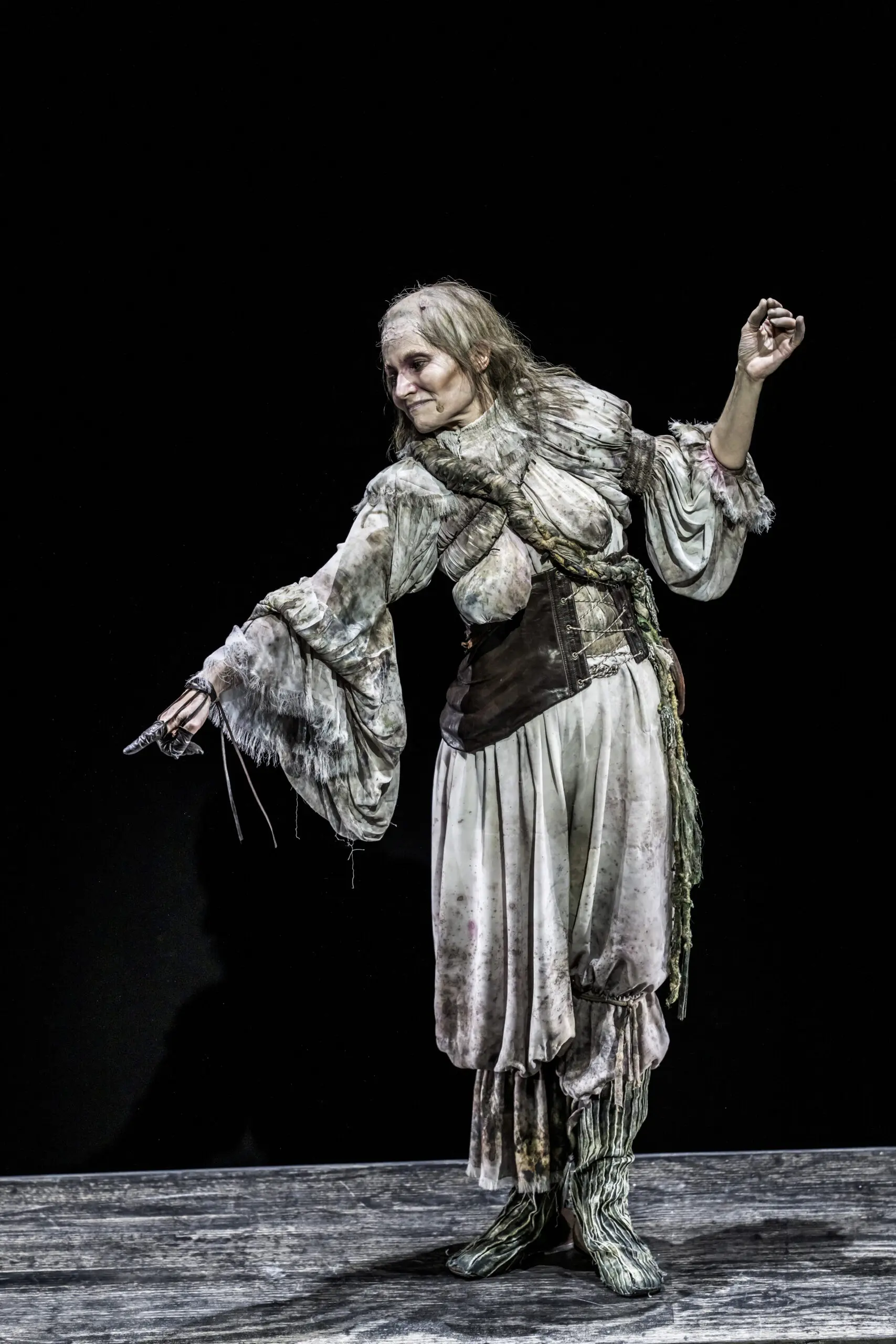
We wanted to push the notion of ugliness, the grotesque qualities women are frightened of: a bulbous breast, being trapped in a corset, a massive rump, having aged in a way that’s socially unacceptable. I play with the extremis of that.
When she’s alone with ‘Rapunzel’, she’s very much a woman, but when she’s playing and tricking everybody else, I caricatures her own punishment in a sardonic way: If you think I’m ugly, I’ll show you ugly. She makes herself more grotesque. I also wanted her to be nimble, in contrast to that restriction, so I get up on the table, hang out of trees and run quite quickly. I thought that would be an interesting contrast for her to be really decrepit, but incredibly quick.
She carries shame and the loss of her mother’s love and that lack of love and parenting feeds her misguided love of ‘Rapunzel’ and her overprotectiveness. Parents should strive to teach their children to walk a rocky road so that they’re resilient; instead, she puts ‘Rapunzel’ in a tower and turns her into some kind of icon.
Then there’s the middle witch who returns to a youthful fountain of energy. We looked at the famous pictures of Pina Bausch with her long hair and a slip of a dress. That reveal is a mixture of fun and levity, but also a gulp of air after being buried for so long.
It’s a collaboration of imagination: where Tom and Jordan started, how I interpret it, what I can give to it. It’s always growing in the rehearsal room. But I also did a lot of work at home, literally standing on my kitchen table, mapping her physicality.
Kate Fleetwood as the Witch in ‘Into The Woods’. Image Credit: London Theatre Direct
What’s your process for integrating vocal mechanics with character choices, especially across such different numbers?
I grew up musically. I play the viola and I was in lots of choirs and youth orchestras as a child. I’ve done a few musicals, though I’m not known for them – maybe that’s changing. I’d always sung but never trained, so this has given me the chance to work with a brilliant teacher, Mark Meylan, both before the Bridge and again now.
There’s the technical side: warming your voice up correctly and cooling it down correctly. But acting through song is paramount, particularly in Sondheim. In all singing, you should be thinking about storytelling, mixed with landing the notes and the phrasing. Just as I’d look at punctuation in Shakespeare to find the end of a thought, you can find it in the dots of the music, i.e. here’s a phrase ending, here’s a new thought being minted.
Repetition is interesting, too, in music as in text. If something is repeated, it’s there for a reason and you can use it to reveal something about the character.
It’s like learning to deliver a monologue to a Shakespeare audience in direct address: you know where you’re going and where you’ll place your voice for certain things. It’s all about placement. That can change nightly; as long as your pegs are in place, you can play with it.
That’s the odd thing about acting. You have to pretend you don’t know what’s coming, while knowing exactly what’s coming so you can prepare for it technically. There’s a bizarre pot pourri of things going on neurologically. If you’re lucky, you’ll have a night where you feel inspired and something fresh arrives that you hadn’t thought of that morning, so you have to be prepared for the intervention of the muse.
Other nights, you give 90% because you’ve got six more shows that week, or a matinee tomorrow – and you do it so the audience would never know. It’s like driving a racing car. It’s always about being in the moment.
How does your own life experience feed into the material?
Repetition is an interesting skill to learn. I didn’t go to drama school; I learned on the job, watching amazing actors, sharing stages with them, working with different directors and designers. But no one teaches you how to repeat something every night. You can to do that.
You have to be in constant alert mode to receive the muse, or the energy the world gives you when you’re playing a part. You might read something in the newspaper that plumbs something interesting, or find a memory. I use my grandmother’s life. She was a wonderful woman, but there were many tragedies in her life and I draw on her a lot for this role, particularly in ‘Stay with Me’ [She pauses]. Sorry – I find it quite emotional, even now. It’s easy to find the things in your life that vibrate in that milieu.
Repetition can be difficult. That’s the task every night: to make it new, as if for the first time. That is the skill of a stage performer and I hope readers will recognise that themselves. It’s tricky, tiring and draining, but it’s worth it.
How do you look after yourself during a run?
Don’t talk to anyone! You’re very lucky I’m talking to you [she laughs]. The irony is that the show is about community, about the ‘I’ becoming ‘we’, but when you’re performing you just can’t talk to anybody.
You go to bed as early as possible. You drink loads of water and electrolytes. After this, I’ll go to the gym and steam my voice in the steam room. I barely drink – maybe once every three or four weeks. I eat really well. The whole day is preparation. There’s never really a time when you’re not making sure the cogs are there and the triggers are alive and vibrant in your body, so you can connect to them as quickly as possible when you’re performing.
It’s pretty dull being in a musical! It’s brilliant on stage, but you have to be super-disciplined. Each genre creates its own discipline and you have to lock into whatever the job needs. Filming is about the immediacy of relaxation and being ready at any moment, whether it’s 5am or 4pm, getting up early and pacing yourself.
Stage is about repetition and making it fresh every night – and it’s physical. I’m getting older and I really notice it. I’m covered in bruises. When I’m at the gym in my swimming costume, I should probably wear a little sandwich board saying: “Don’t worry, I’m fine. I’m just in a show.”
In a musical, your voice and body can calcify overnight when you stop, so in the morning you’re unfurling physically. If, for instance, you’re playing Medea, you’re psychologically unfurling and then you start psychologically furling yourself back up again come three in the afternoon.
What does screen work give you that theatre doesn’t and vice versa?
I’ve done plenty of day-playing and it’s so tricky because you don’t know anybody. Everyone’s having a great time on the make-up bus but you feel like you’re late to the party and everyone’s made their friends already. It’s hard to know what tone is of the performance that’s required and you don’t even know where everything is. It’s the hardest thing, but we all have to do it.
If you’re a regular in a series or central to a film, you learn how to relax on camera and that’s the gold. You need to be relaxed, spontaneous and listen. You never really know if it’s happening, but you hope it is. On Harlots, which I did for a few years and The Wheel of Time, I got to feed into the character and costuming, which was really exciting – “We’re doing this wig next season, we’re thinking about this storyline.”
The scale and detail of those big shows are unbelievable. And it’s another leap of imagination: you’re pretending to be on a spaceship while three people in jeans and bomber jackets stand right next to you. There’s something thrilling about doing a scene and letting it go – I’ll never say that again; on to the next. And you get the odd day off!
But the best thing about theatre is being in a company. It’s like a family: you look after each other and look out for each other and you’re all in simpatico with each other. It’s a microcosm. You don’t get that as a day player.
And whether it’s stage or screen, you never know what will land. You go in with an open heart and an open mind and hope. We made Into the Woods with love, discipline, detail and commitment, like a million other shows every year and we didn’t know if it would be any good. So when people respond to it, it’s one of the best feelings.

Kate Fleetwood as Liandrin Guirale in ‘Wheel of Time. Image Credit: Prime Video © Amazon Studios
What was your route into acting and how did your background shape your work?
I was really lucky. My mum and dad moved to a farm outside Stratford-upon-Avon, where my dad was farm manager. Back then, there was always a fireman on duty at the RSC and he got two free tickets for every press night, like everyone who worked in the theatre. He didn’t want them.
His mum worked on our farm and knew my parents loved theatre. They were originally from Liverpool and my mum has always loved theatre, art and poetry; she’s a great inspiration to me. So every few months we’d get those tickets and I watched a lot of plays as a little girl.
Then we saw an advert in the Stratford Herald; I auditioned and became a child actor at the RSC. I worked with some amazing actors, all of whom told me not to go to drama school – probably the wrong advice, looking back! But university was free then; drama school has always been expensive and we simply couldn’t afford it. So, I went to Exeter University.
In my first year, the director John Retallack of Oxford Stage Company came to see something I was in, which was pretty unheard of. It was a practical course, but not a vocational one: no casting directors, no agents. I didn’t even know you needed an agent. He left a message at reception saying he’d like to work with me when I finished.
The week I was doing my finals, I auditioned for something in the Oxford Stage Company. I thought I’d completely messed up my dream of being an actress and thought I should have found a way to go to drama school, or done a postgraduate course at Webber Douglas, but I couldn’t even afford to get to London. Then the phone rang: Oxford Stage Company wanted to see me for a recall. I said I couldn’t; I was sitting my finals. They said: “Never mind, you’ve got the job.” I owe John Retallack a lot.
I toured mid-scale with Oxford Stage Company for five years and got seen by directors along the way. Dominic Cooke saw me playing ‘Viola’ in Twelfth Night and a year later, called me in for Arabian Nights. From that, I got a good agent. But it was a really hard slog for at least 15 years. I cleaned, I waitressed.
And it’s still not easy. You go from one job to another. I’m in a better position now, but I don’t know what’s happening in January when Into The Woods finishes. You have to do a lot of mental aerobics as an actor and dig deep all the time. It’s lonely, too: you go from being in a company to being on your own.
Has the industry changed since you started?
When I was starting out, a whole generation of us would meet in Soho for advert auditions or, if we were lucky, an audition for a BBC show like Casualty. You’d bump into your peers in Soho or outside the room and you all got to know each other. It was collegiate, not competitive, because at least one of us might get it.
I understand the democratisation of self-tapes, of course, but they’ve taken a lot of that community feeling out of the industry. It’s really hard.
What’s the most useful thing you’ve learned about auditioning?
Treat it like a rehearsal.
What do you wish someone had told you when you were starting out?
The best thing I’ve learned, from Fiona Shaw, is to let gravity let you fall when you’re playing in the rehearsal room. Play, play, play until you find it. Be brave. If you fall over and look ridiculous in rehearsals, you won’t do that on stage, because you’ve decided that isn’t the right thing to do, so you move on to the next idea. It’s all about being courageous and trying our ideas.
And play a really big role in something, even if it’s a short film. Get the chops going. It’s really important to keep doing it.
How do you handle the lows, as well as the highs?
I don’t really. No one does. You keep plodding on and you have faith. The precedent will suggest I’ll work again. And look back at where you’ve come from rather than always looking up at where you want to be, which can be overwhelming. I didn’t go to drama school. I didn’t know anybody in the business.
I didn’t work for a whole year after I was nominated for a Tony. But I’m still here and I’m still having some of the best experiences of my career. So, remember the rocks you’ve overcome, look down rather than up and say: “Hey, I’m doing okay.”
What are some of your career highlights?
Three big shows that landed: London Road, Macbeth and Into the Woods. I had no idea they’d be like that. It was the magic, the collaborations and the material. The material has to be good.
How has your definition of ambition evolved?
I’m still really ambitious – I’m not going to pretend I’m not, at 54. In fact, I’m probably more ambitious than I’ve ever been. I’d love to do some screen work that might be surprising to people, something new that I’m not known for. Above all, the ambition is about working with good material.
I’ve just done my tax this morning, as it happens, and there’s a quiet satisfaction in it. There’s something to be said for contributing through what you do, even if it’s 200 quid. It’s hard to make a living and there were many times I didn’t and I still called myself an actor. You contribute in so many ways when you’re not earning as an actor: teaching, mentoring, encouraging your friends when they’re down, keeping the faith. That hidden stuff is part of being an actor too. It’s an everyday experience, even when you’re not working.
Finally, what should audiences expect at the Noël Coward Theatre?
It’s like a box of Quality Street to look at. It’s amazing. Expect to be profoundly moved. And the music: when I’m tired in the wings, repeating it for the umpteenth time, all I have to do is listen. Oh, that’s an amazing piccolo. I’ve never heard the French horn do that. It’s so rich, with all these little Easter eggs, that you could never be done with it. I’m going to be so sad when I stop.
Doing Sondheim is like making a patchwork quilt. You’re just adding your patch: this is my Witch. Then someone else will make a Witch patch, a Cinderella patch or a Little Red Riding Hood patch and you just hope your little patch becomes part of its legacy.
Into the Woods is at the Noël Coward Theatre, London, until 9 January 2027.
Into The Woods Discounted Tickets for Spotlight Members
Spotlight members can access discounted tickets from £40.50 as part of London Theatre Direct’s Black Friday Event, running from 13 November until 7 December.
How to claim your theatre ticket discount:
- Sign in to your Spotlight account
- On your account homepage, either click the link found under the Spotlight x London Theatre Direct header, or navigate to Discounts in the quick links section
- Browse the live offers to secure your discounted seats
Join Spotlight or sign in to your account today to ensure your profile is casting-ready and get discovered by the casting professionals bringing these incredible stage stories to life.