
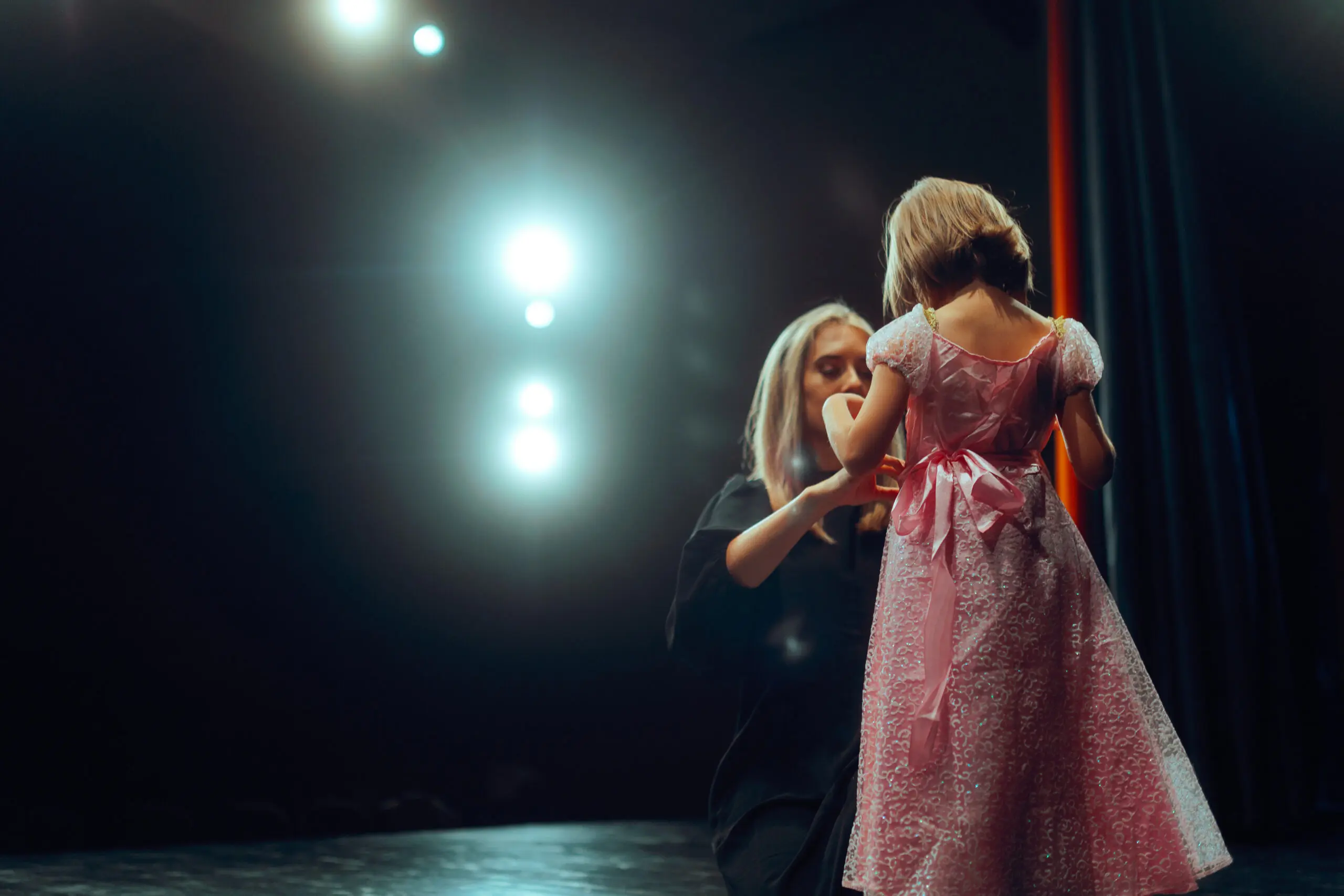
A practical guide to helping young performers understand informed consent in acting.
Performing can be an exciting, creative and hugely positive experience for young people. However, a rehearsal room, film set or photoshoot can sometimes involve situations where a child needs to understand what is being asked of them and be able to say if they are uncomfortable or need to pause.
The industry has become increasingly aware of the importance of boundaries, particularly around physical contact and emotionally demanding work. There are now brilliant intimacy coordinators and clinical psychiatrists working with productions to help make sure performers feel safe and supported.
Young performers need to know that their voice matters and, importantly, that they won’t get into trouble for speaking up.
What Does Informed Consent Mean?
Informed consent means understanding what you are agreeing to.
Before taking part in something, whether that’s a costume fitting, a stage fight, a difficult emotional scene or physical contact with another performer, a child should understand what is going to happen.
They should know:
- What they are being asked to do
- How it will happen
- Who will be involved
- And, where appropriate, why they are doing it
For consent to be informed and meaningful, three things are important:
- Understanding: The child needs an age-appropriate explanation they can actually understand. Telling a five-year-old that a scene has been “risk assessed” isn’t the same as explaining what will physically happen during it and how they will be kept safe.
- Choice: A child shouldn’t feel bullied, embarrassed or guilted into agreeing to something because they don’t want to let anyone down, or because everyone is waiting and there is pressure to get on with the scene.
- Speaking up: Agreeing to something at the beginning of a job doesn’t mean a child has signed away their right to raise a concern if something changes or no longer feels right to them.
A child should always be able to ask questions, say when they are uncomfortable and seek support from the adults responsible for their wellbeing.
“The right to be heard is a fundamental aspect of the UN Convention on the Rights of the Child. Ensuring a child has both choice and a voice is essential both for safeguarding and for ensuring that their employment situation does not tip into something that looks more akin to exploitative child labour. Children should always feel able to choose whether to work or not and feel able to speak up about things they are not comfortable with.” – Amelia Knott, Human Rights Consultant
Why It Can Be Hard for Children to Say No
Children are often very good at doing what adults ask of them. That’s particularly true for young performers, who may be keen to be seen as professional, cooperative and easy to work with.
Children who work professionally can also become very good at trying to please the adults around them. They may say they are fine even when they aren’t, particularly if they can see that everyone is busy or waiting for them.
Some children worry that asking a question will hold everyone up. Others may be concerned that saying they don’t want to do something will make them look difficult or affect their chances of being employed again.
This is why simply asking a child, “Are you okay with that?” isn’t always enough. Sometimes it can help to ask a question in a different way.
You might want to try:
- “How do you feel about doing that again?”
- “Is there anything about that scene you want to ask more about?”
- “Did anything happen that you weren’t expecting?”
- “Would you like a minute to think about that before answering?”
Giving a child time and space to think can sometimes be just as important as asking the question in the first place.
Talk to Your Child About Boundaries
As their trusted grown-up, you can help your child understand that being professional doesn’t mean agreeing to everything without question.
“Being professional means turning up prepared, listening, working collaboratively and treating other people with respect: It does not mean ignoring your own discomfort to please somebody else.” – Dr Lucy Shoolbred, Chartered Clinical Psychologist
It’s also worth talking about the difference between something being challenging and something crossing a personal boundary.
You can teach your child to use these simple phrases:
- “I would like to pause for a minute? I’m not sure I understand what I’m being asked to do.”
- “Could you explain what will happen before we try it?”
- “I would like to have a minute to think about that.”
- “I’m not comfortable with that. I would like to speak to my chaperone.”
Understand That Not Every Child Will Speak Up
Not all children respond to discomfort by saying “No.”
Some may go quiet, become unusually withdrawn, laugh things off or simply say they are fine because they don’t know how to object. Others may agree to something because they feel under pressure or don’t want to disappoint anyone.
The adults around the child should pay attention to the child’s behaviour and body language, give them time to think and make sure they genuinely understand what is being asked of them.
Consent in Specific Situations
Costume, Hair and Make-up
Costume fittings, hair and make-up can all involve adults working in close physical proximity to a child.
Your child should know that it is okay to ask questions about what is happening and to say if something is uncomfortable. Wherever possible, adults should explain what they are doing and ask for consent before touching a child.
A child may also want privacy when changing or feel uncomfortable with a particular costume. These concerns are valid and your child should feel able to raise them with the appropriate member of the team.
Physical Contact
Children should know what contact is expected before rehearsing or filming it. This might include hugs, lifts, dance movements, stage fighting or other physical interaction.
If something changes, or another performer repeatedly makes contact in a way that hasn’t been agreed, your child should feel able to flag it.
A useful phrase for your child to learn is:
“That was different from what we practised. I would like to talk it through before we do it again.”
Emotionally Demanding Scenes
Young performers are sometimes asked to play fear, grief, anger, or distress. These scenes can be creatively challenging without requiring a child to draw on genuinely upsetting experiences from their own life.
Your child should never feel pressured to share personal information or memories in order to prove that they are committed to a role.
Adults directing children should also be particularly careful not to deliberately frighten, shame or upset a child in order to get a particular emotional reaction for a performance.
After an intense scene, a child should be offered a few minutes to reset. That could mean taking a break, having a drink, chatting about something completely unrelated or simply stepping away from the character for a moment.
“Children in these roles are often brilliant at reading the room and doing what’s asked of them. That’s exactly why adults need to keep checking in. A child playing distress doesn’t need to have lived it and no performance is worth a young person learning that their discomfort is something to push through quietly.” – Dr Lucy Shoolbred, Chartered Clinical Psychologist
What Happens When Something Changes?
A change doesn’t automatically mean there is a problem. But a last-minute change shouldn’t mean that a child has to agree without asking questions simply because everyone else is ready to go.
If something new involves anything else that hasn’t previously been discussed, it is reasonable to pause and make sure the child understands what is being asked of them.
They should also have an opportunity to speak to their parent, chaperone, or another trusted adult before agreeing to go ahead.
Consider What Happens After the Job
Informed consent isn’t just about understanding what will happen during a job. Taking part in a production can have an impact long after the job has finished.
A child may become recognisable, receive attention on social media or find that friends and classmates have opinions about the programme or character they played. It can be helpful to talk, in an age-appropriate way, about what might happen when the job is released and how they might feel about being recognised or receiving attention (either negative or positive).
You can’t predict every consequence of a job, but helping your child think about what might happen afterwards is another important part of making sure they understand what they are agreeing to.
Red Flags
Not every awkward moment is a safeguarding concern, but some things are worth paying attention to:
- A child being asked to do something significantly different from what they had been told to expect, without a proper conversation about the change.
- Pressure or guilt being used to persuade a child to do something they have said they are uncomfortable with.
- Comments such as “Don’t hold everyone up,” or “Everyone else is fine with it,” when a child raises a concern.
- A child’s pain, distress or discomfort being laughed off or dismissed.
- Adults deliberately trying to frighten or upset a child in order to get a particular performance.
- Adults trying to discourage a child from speaking to their parent, chaperone or another trusted adult.
- A lack of clear planning around scenes involving physical contact or potentially sensitive material.
If something doesn’t feel right, ask questions and involve the appropriate people. This could be a chaperone, designated safeguarding lead, or the child licensing officer at your local authority.
A Quick Check In Before Starting a Job
It can be useful to make sure your child knows the answers to a few basic questions:
- Do I understand what the job involves?
- Are there any scenes involving physical contact, challenging emotions, or potentially uncomfortable costumes?
- Do I know who my chaperone or trusted adult is?
- Do I know who to speak to if I am worried or uncomfortable?
- Do I know what I could say if I need something to stop or pause?
- Do I understand that I can ask questions if something changes?
- Do I feel comfortable with what might happen when the job is released and how I might feel about being recognised or receiving attention?
A professional environment should allow time for questions. It should give a child space to ask for help or clarification. It should also have enough flexibility to explain things properly and make sure a child understands what they are being asked to do before they agree to do it.
The rules and guidance surrounding child performance can change and different productions may have different procedures in place. If you have concerns about a particular job or situation, speak to the relevant chaperone, safeguarding lead or local authority licensing team.
About the Writer: Rachel Barnett-Jones – Writer, Producer and Sensible Creative
Rachel is a writer, educator and arts advocate. As the founder of Sensible Creative, she is committed to dismantling the complexities of the professional arts and lecturing on the ethics of safeguarding to ensure that creatives, especially the most vulnerable, are protected, informed and respected.
Her work as an advocate is built on a career of world-class storytelling, with writing credits spanning television (Sky Kids’ Pip and Posy, S4C/ITV’s Tiny Buds), audio (Tonies, Lapland UK), and international theatre (Polka, Chichester Festival Theatre, Singapore Repertory Theatre, York Theatre Royal), as well as her work as a producer, educator and researcher.
By merging her creative practice with a tireless commitment to practical kindness, Rachel is currently working on a variety of projects which, she hopes, will make the arts a happier and healthier place to work.
Useful Resources
Parent Guide Through and After Filming: Dr Lucy Shoolbred has a free guide for parents and covers both informed consent and managing the time after a project. Download it here: https://drlucymedia.com/download-guide
Spotlight: Young Performer Resources
https://www.spotlight.com/news-and-advice/young-performers/young-performer-resources-industry-hub/
NNCEE: Child Performance Information and Resources
Equity: Safeguarding Information
Sensible Creative: Access Riders for Young Performers
Resources and guidance designed to help young performers communicate their individual needs and access requirements.