
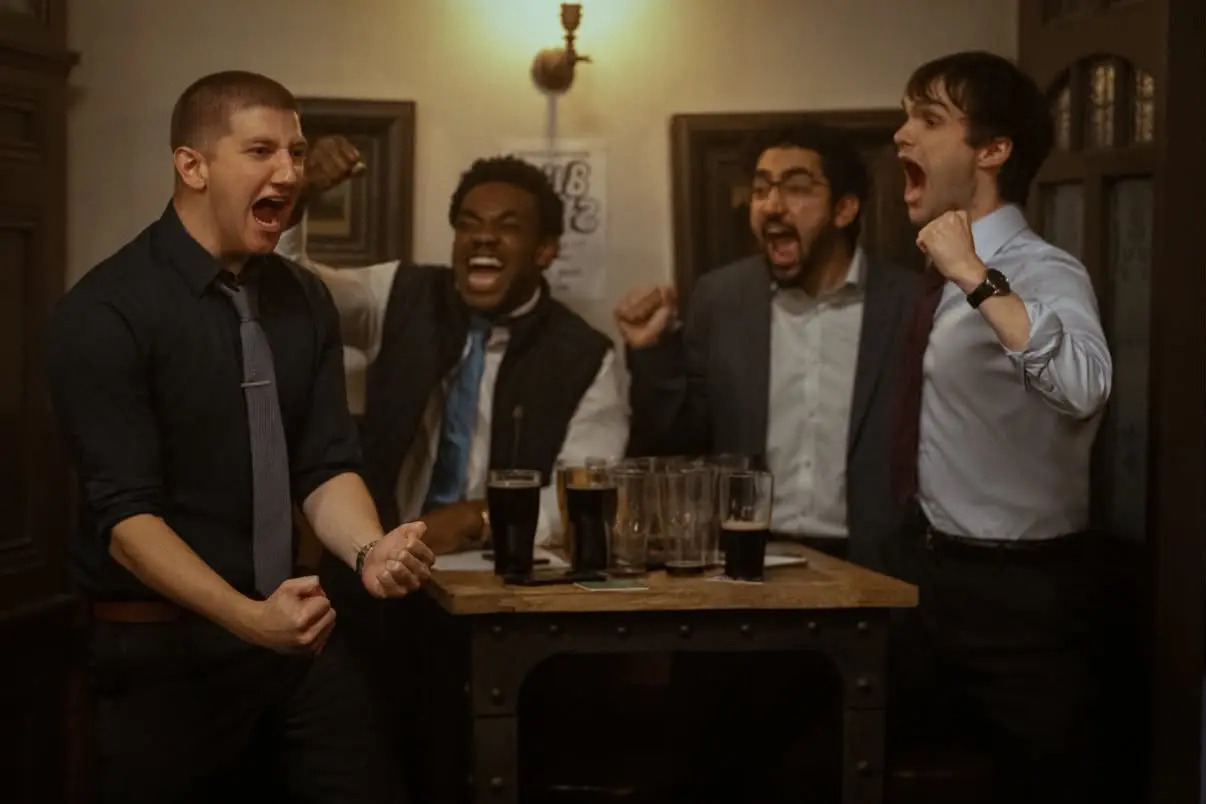
Actor Jake Bailey talks about transitioning from stage to screen after stepping onto the set of hit comedy-drama ‘Ted Lasso’.
Joining a hugely successful, globally loved show can be a daunting prospect for any actor, but for Spotlight member Jake Bailey, landing the role of ‘Ozzie’ in Season 4 of Ted Lasso was a dream job.
From taping auditions at home with his mum to stepping on set alongside Jason Sudeikis and the rest of the AFC Richmond and Lady Greyhounds’ family, Jake’s journey highlights the power of adaptability, persistence and staying true to your craft.
We caught up with Jake to discuss his casting story, his advice for actors making the leap between stage and screen and how embracing a total hair transformation helped kickstart his screen career.
Hi Jake. Can you tell us about the audition process for your role in ‘Ted Lasso’?
I was asked to do four scenes of varying lengths from the episode; this was from the first episode I featured in, episode 4, the one about the quiz, one winding the girls up, one for the fight and one for the prison scene. I learnt these, taped them with my mum and sent them off. Around three to four weeks later I got a call from my agent – I’d already thought that maybe this one hadn’t gone my way – to tell me I was down to the final four. So not even a recall!
A week later I checked my phone to see a message from my agent with my headshot, the Ted Lasso poster beside it and, of course, a GIF with ‘BELIEVE’. I replied, “I got it?!” We then called and the rest is history.
How did you interpret ‘Ozzie’ from the script and bring your own energy to the character?
I think it’s important not to overthink it. The script spoke for itself and having been around ‘laddy’ boys my whole life and seen a few ‘finance bros’, it was time to dig deep into the Essex accent and think of football away days and the sort of bloke who in their eyes, could do no wrong. A group leader but also just a complete misogynistic idiot. So, I leaned into it and thankfully, it worked.
What was it like stepping on set and building a bond with the cast?
A year before, I’d been to the Ted Lasso pub as a fan, so to then be on the set was quite surreal. Stepping in at episode four didn’t feel like we were coming in late. It’s a huge family that welcomed us, so straight away the nerves were put at ease, and I felt like part of the company.
The first day is always exciting. I got to choose my costume. Jacky [Levy], who was the costume designer, had different options and allowed me to talk about what I thought the character would wear to make sure that the other boys and I fit as a group.
Then we had a rehearsal where we met the cast, which was great because we formed relationships before having to step onto set to pour a beer straight over ‘Gemma’ (played by Abbie Hearn) and get spat at and bottled by ‘Boots’ (Jude Mack). That was a fun day. Me and the boys got on like a house on fire, so we knew it was going to be a good one.
We had time between takes and on lunch to sit and chat to continue to build relationships, which was important for the job because it allows a level of respect, trust and comfortableness. I gained friends forever on this job.
How did your live performance experience help you with working on camera?
With the scale of the show, you know it’s going to have the best of the best people working on it, so you have no choice but to bring your A game. But there’s a comfort in that because you know that every department you walk into and meet, whether it be make-up, camera, lights, rigging – the list goes on – you know you’re in good hands. I think stage performing helps because you continue to do the same thing and let the other departments do what they do so it all comes together.
One thing that I found different was being there for eyelines when not in shot or cheating an angle slightly because of where the camera was. But through my training and work experience, I know how to judge and find my mark without making it obvious, so it came pretty naturally.
The most nerve-racking thing was making sure that I was pouring the pint properly – otherwise it wastes time because of the turnover of costume and make-up for Abbie.

Jake’s headshot that was submitted for ‘Ted Lasso’. Photo credit: Kody Mortimer
Did you make a conscious choice about transitioning between stage and screen work?
I was lucky, as a kid, to do both, so I already had experience in both worlds. Musical theatre was what I trained in for three years and found my casting – a big quiff being a part of that! But things slowed down a bit and I’d thought about TV for a while, so I took the plunge, cut my hair off and went for the buzz cut. Lo and behold, the hooligan jobs came in thick and fast!
However, I’m still open to both as I love different aspects that they give, but being able to do such a dream job was really special. Always trust your process, whether things are quick or slow – it’s coming.
How do you stay centred on your craft during times of uncertainty?
I knew this industry was for me, in whatever capacity, from the minute I was born and no matter who said I wouldn’t make it whether it was friends or teachers – it gave me that fire to go, “Watch me”.
No matter what job I do, I give 100% of what I’ve got, no matter how ‘big or small’, it is. I would always give it everything; otherwise I find it rude and disrespectful and, more importantly, you’re just doing yourself an injustice. Our craft is to create a believable character, so do just that.
What advice would you give yourself as an actor just starting out?
No matter where you are in your career, my advice would be to just give everything a go. If given an opportunity, why would you not want to potentially add another skill set?
Meet people, push yourself and be kind. People want to work with good and talented people and if you’ve met someone and been good to them, you never know what casting team, director, choreographer, etc is going to pick up the phone and go, “What was x like to work with?”
It’s not just about what you do on stage or set; there’s a lot more to it. You have to be able to take notes and change things instantly, so test that when you’re practising.
On Ted Lasso, you’d get your sides the night before, but there were times you’d wake up and there’d be a new set to learn on the way in, or sometimes even while in the make-up truck. So, you have to be ready to pick up and learn quickly.
On set, Jason Sudeikis would obviously give notes, but he was amazing because he also would come up and say if something didn’t work and would ask me what I’d need for it to feel more natural and help the delivery. He allowed me to put my piece in for it to work. You have to be able to take the note, change the line, put it in your head and go. One time, my note came as they shouted, “Turnover”, so it was time to lock in and go. But I loved that; it forces you to take notes and become a better actor.
What advice would you give your younger self about the industry?
Relax and enjoy the process and ride the highs and lows – it’s all going to be okay.
I’m a bit of a control freak, so I have to be overprepared, but I had to learn to find the line with that. Learn your lines, be prepared and keep working on your craft, even when you’re not working.
My biggest thing with line learning is that you have to tap into your short-term memory, lock in and learn it with no distractions. If you have more time, do it before bed, learn it, sleep on it and for some magical reason, when you sleep, it will stick.
And finally, trust yourself. When training and in life, enjoy failing, enjoy figuring things out. Learn from it and adapt. Always give everything 100%. Be kind, be on it, be prepared for change and always support people because it feels good.
There’s a place for everyone in this industry and sometimes some people have to wait a bit longer than others. Don’t be scared to switch it up and, more importantly, be completely and unapologetically you. You’ve got this.
A huge thank you to Jake for taking the time to share his journey and practical insights with the Spotlight community. Keep up with Jake’s latest work and upcoming projects by checking out his Spotlight profile and following him on social media.
Join Spotlight or sign in to your account today to ensure your profile is casting-ready and get discovered by the professionals bringing great stories to life.