
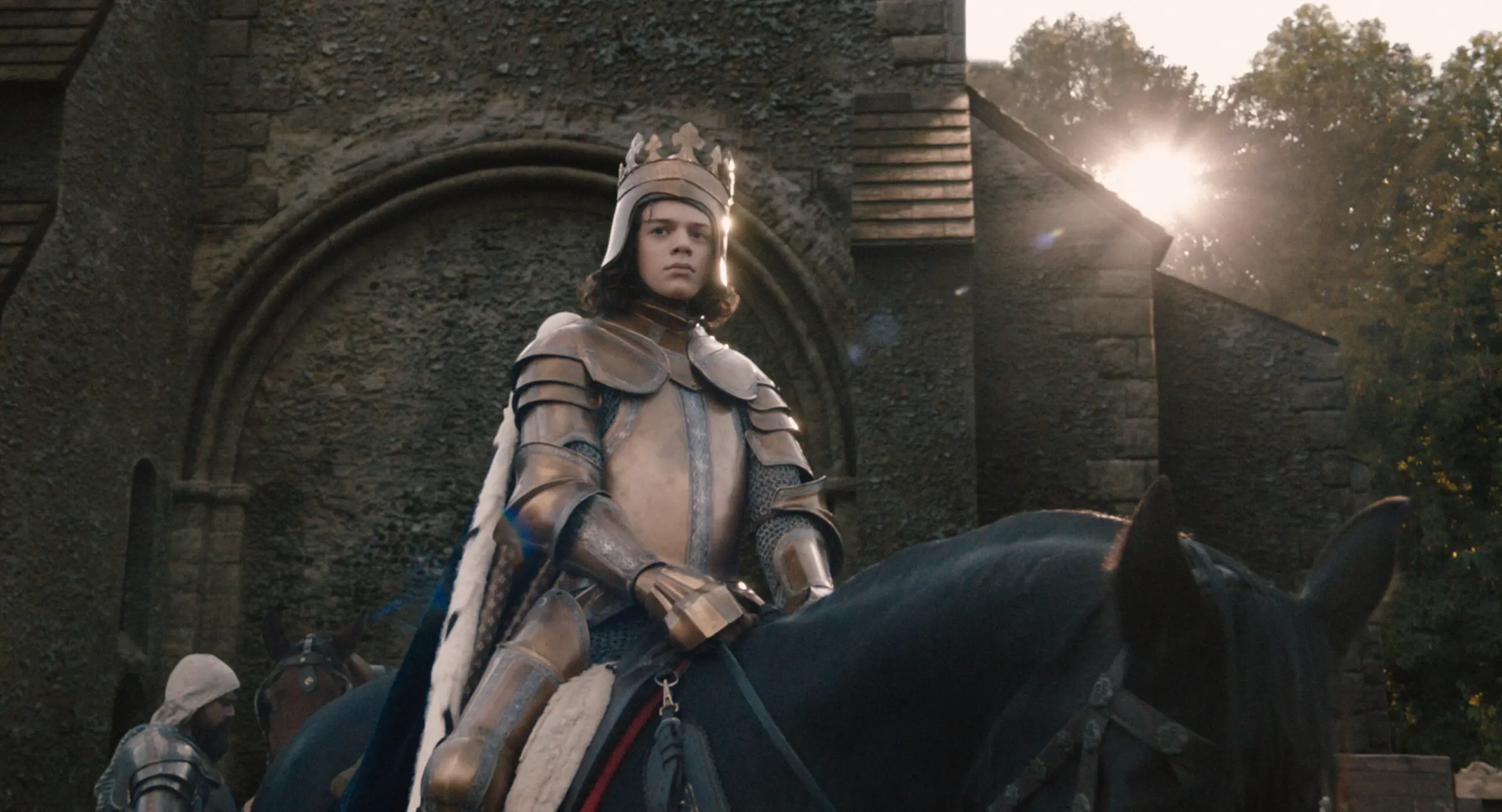
Young Performer Woody Norman discusses Paul Greengrass’s The Uprising, his instinctual approach to acting and working with Joaquin Phoenix.
Rising star, and Spotlight member, Woody Norman sits down with us to discuss his latest role as ‘King Richard II’ in Paul Greengrass’s historical epic, The Uprising. From his early beginnings starting out as an actor at just five years old to navigating major US blockbusters alongside actors like Joaquin Phoenix, Woody shares a candid look into his instinctual acting process, his love for on-set improvisation, and what it takes to portray a complex young monarch.
Can you tell me a bit about how you got started in acting?
I learned that my auntie was an actress when I was five, and I just asked my mum if I could try it. I liked it, so I carried on doing it.
I tried out for the Sylvia Young agency – I’m still with the agency today – and ever since then I was like, “This is what I like doing.”
Do you remember the moment you decided acting was going to be your career?
I think I always knew. When I was younger, I was like, “This is just good fun, I want to keep doing this.” But now that I’m getting older and people my age are getting jobs, I’m like, “This is what I want to do as mine.”
How do you and your family balance acting with normal life and school?
We decided to take it very slow and not do anything that would catapult me into anything when I was really young because I enjoyed going to school and playing with my mates. As an early teen, I enjoyed doing what other people my age were doing. Now I want to go for it.
You’re in ‘The Uprising’. Can you tell us a little bit about your role?
I play ‘King Richard II’. He’s a very disturbed boy who happens to be the King of England. Think ‘King Joffrey’ in Game of Thrones but what people thought about Joffrey is true with me. I’m being taken advantage of by my counsel, and I do even worse things than Joffrey did. He’s a very egotistical and very religious person, who thinks the things he does are being ordained by God. He’s a very scared person.
My process is that I don’t have one. I barely learn my lines, I just do it so that I can recite it back…The only way that you could have that breakdown moment is if it just happens.
What preparation did you do for your character or for the film in general?
My process is that I don’t have one. I barely learn my lines, I just do it so that I can recite it back. I won’t stand in front of a mirror and look at my face while I do it to see what it looks like because you don’t do that before a conversation or before an intense moment. The only way that you could have that breakdown moment is if it just happens. And there’ll be a lot of takes where you have to go, “No, cut, didn’t happen” and it will take longer in that way, but I find it makes it truer.
How did you approach playing a king who has immense power at such a young age and navigating the pressure that comes with that?
I think he’s very similar to those people in school who you could tell have never been told no before. He was the king of England, no one would tell him no so he was just a brat and it had gotten to his head. He was at that age where you can tell someone’s been spoiled as a kid and now they’re suffering from it. He was very spiteful, and that was quite easy to play because I think anger and hate are very natural emotions that you can let out when you’re acting.
Can you tell us a bit about what your day looked like on the set?
Very early starts. Wake up at 7am in the morning – which might not be very early for a lot of people – and go to the set. I spent a lot of time in hair and make-up because my hair is not that curly. I’ve got curly hair, but [my character’s] curls were tight.
The costumes took ten minutes to get on because they were so big. Then I’d have to be helped to set and get on the horse, which was a whole thing. Honestly, you stay on your horse for the day, you don’t come off him so lucky for me, he was a big stallion.
Is horse-riding a skill you had to learn for this?
I had done it a bit as a kid on The White Princess and Poldark, but I found a real love for it on this job and I still do it now. I’ve been taking a break over the summer because it’s been 35 degrees and I will collapse by horse-riding in that, but I absolutely adore it.
Did you have to do any other training for the film?
I had to do a lot of accent prep. Actually, we didn’t end up using it because I found a few of the elements a bit distracting. Originally, [King Richard II] was supposed to have a stutter and speak in this very high falsetto, and I couldn’t act while doing, especially the high voice because I felt a bit silly. But through learning to let myself go into that cartoonish territory with the character, I think that’s what made me find the way I’d play him.

Woody Norman. Image by Jenny Smith
When you were being directed by Paul Greengrass, did you have much room for improvisation or to experiment?
Yes. He is my type of director! He’s like, “If it doesn’t come to you or it doesn’t happen, don’t make it.” His way of filming is very, “You move around the set and we will follow you.” You don’t have marks and that’s always the way that I work, to many a director’s dismay. I like being in the room and finding my way around the scene, and he does as well, so that was perfect for me.
What was the audition process like?
I did my only audition for it the same day that I saw Oasis at Wembley. We went to the audition, I did the performance in that sort of dissociated, high-pitched way and then I went home, got changed and went to see Oasis.
How do you handle auditions and shaking off any disappointment?
My advice would be if you got an audition, don’t get attached to it. You’re going there not as a way to prove yourself to those people, but for them to see if you look right, usually. Most of the time if you do a good performance, they know that and they will keep that and they will use you later. But it’ll just be because you had too long hair or your eyes were the wrong shape for the role or this, that, the other. So just forget about it. It doesn’t matter, you’ll get another.
Being young in the industry […] is such a strange and surreal experience. In the best way possible, it’s a really odd childhood.
You’ve worked with other actors who started young in the industry like Andrew Garfield and Jamie Bell. Did you talk about navigating an acting career as a young performer?
With Joaquin [Phoenix], we spoke a lot about that and really related to each other as people that were in the business quite young. But me and Andrew, we didn’t have too many scenes together, so we didn’t really get to know each other too well but he’s an absolutely lovely bloke. When I see him, it’s all smiles, he’s great. But a lot of actors really are open to speaking about that. Jamie Bell, we spoke a lot about being young in the industry. It’s such a strange and surreal experience working as anything when you’re seven years old. In the best way possible, it’s a really odd childhood.
Was there anything that came out of those conversations that stood out?
Being absolutely obsessed with acting. And at that young age, not caring about films. When I was eight years old, I was watching the new Marvel movie in the cinema maybe, but I didn’t care about cinema, I liked acting. I found that love for cinema later, and it gave me a new passion for the work I do.
What did you take away from being part of ‘The Uprising’?
When working with other actors on such an extreme film, completely letting go of your ego and almost your self-preservation. You don’t want people to see you as this guy that can do all these embarrassing things, you still want to still seem cool [so it’s] just forgetting that and kind of getting your ego from who can do the strangest thing.
What’s been the most helpful thing your parents have done to support you on set or off set?
When I was very young, mum would keep me away from everything. I wouldn’t go to wrap parties, I wouldn’t be around people I was working with unless I was working with them so that I could still be a child, you know what I mean? And not grow up too quick. I was lucky enough to have my mum agree with me that I didn’t want anything too big, too young. So I think that’s the most important thing.
Would you say that’s your career highlight so far?
C’mon C’mon is my favourite film I’ve done for sure. Not even just because of quality, but because of memory. It was the best experience. The best time of my life was October 2019. I had the most fun, everyone on the set was lovely, we’re all mates and we still see a lot of them today. I’m at a point where if I’m nervous about a role, I can call up Joaquin. I’m so proud of the film. I’m blown away by it.
On the first day of shooting, Joaquin wanted me to try method acting for it, to try staying in character. He just wanted me to keep my accent because I wasn’t very good at the start. I went to my mum and said, “Can you tell him I’m not doing that?” And through that, we allowed ourselves to play ourselves in the film. I mean, Joaquin was playing Joaquin. There was no difference between ‘Johnny’ and Joaquin and there was no difference between ‘Jesse’ and me. The only difference is the accent.
Most of the film was improvised. Obviously, the story was set in stone, but we would run it once and then go, “All right, go, do your thing.” And whole scenes would be made up on the spot, which I think set me up for disappointment with other films. On the next film I was like, “Oh, the scene’s stopping when I get a line wrong.” And that was a bit like whiplash, you know what I mean?
How do you handle directors who insist you stick strictly to the script?
I’ll be honest, I hate it. I think it’s not human. You’ve got to let what’s natural to the actor come out, unless the piece of dialogue is crucial to the film. If it can be changed by the actor and the bit of improv is good, let it be. I know it might be difficult for a writer for someone to change your work because it’s like your baby but it’s usually because it just feels natural and it will come across as natural in the film.
You got nominated for your role as ‘Jesse’ in C’mon C’mon. How involved did you get in award season?
It was a bit of a half-and-half just because of the timing as it was still COVID. But I went to the BAFTAs and I remember not a thing from that night because of the adrenaline. But that was just such an amazing period of time that I’m very happy I can look back on it.
What has stuck out as the main differences between acting in the UK and the US?
It’s way bigger. When you do a film with the Russo brothers [like The Electric State], no one’s out of their tents, everyone’s doing stuff remotely, and everything’s huge. It feels so much more like, “Oh, this is a job!” It feels like this massive production. Everything is just an extreme version of what it’s like filming, even on an indie film – I did C’mon C’mon in America and that was quite independent, even though it was an A24 drama – it still had that feel.
Would you like to do stage work?
I would love to do a play. I used to be very against it because of the improv thing but I’ve been getting into plays recently and I really like them.
What do you do to keep creative between roles?
I’m in a band and we just put out our first demo. I like making art, whatever it may be. It doesn’t matter if it’s acting, directing, writing, whatever. As long as I’m making it, I’m happy with it and I want to do it.
What do you want to see in your future?
I think I’m going to just live la vida loca. I’m going to do what I’m doing and let the wind take me where I’m going. I’m very against setting out plans for myself. If this happens, it’s going to happen and I’ll let it take me.
With a performance that promises to deliver an unvarnished look at absolute power and vulnerability, Woody Norman’s turn as ‘King Richard II’ marks another bold step in an already extraordinary young career. Wherever the wind takes him next, one thing is certain: he will be approaching it on his own terms, guided by instinct and a genuine love for making art.
The Uprising is released in UK cinemas on 9 October 2026.