Expert Zhenya Leverett explains how mastering the art of stage combat transforms physical action into powerful storytelling.
Many actors view a fight call as a series of boxes to tick – a punch here, a fall there, and a prayer that no one actually gets hurt. But as both a professional actress and a fight director, I’ve seen firsthand that the most captivating ‘violence’ on screen and stage has very little to do with the physical impact and everything to do with the emotional truth behind it.
Whether I was trading punches with Jodie Comer on the set of Killing Eve or choreographing a complex sword duel for the stage, the lesson remained the same: you aren’t just hitting a mark – you’re telling a story.
In this article, I pull back the curtain on why proactive training is your greatest professional asset, how it shifts the way you collaborate with your fellow actors, and why – above all else – mastering the illusion of conflict is one of the most transformative tools in any performer’s toolkit.
In this article, you will learn:
- The difference between production rehearsals and foundational skill building.
- Why specialised movement backgrounds like dance or martial arts require a specific shift in mindset for the stage.
- The direct link between your current technical proficiency and the complexity of the fight choreography you’re assigned.
- How consistent physical training serves as a professional business card during the casting process.
- How mastering stage combat can improve your overall craft as an actor.
Why Stage Combat Training Matters
As a stage combat teacher and fight director, I often have students ask: “If I get cast, they’ll provide the fight training. So why bother learning this now?” The reality is that fight rehearsals on a job are not training – they’re choreography for a specific scene, working with the skills you already bring. Those sessions focus only on solving immediate production needs, not on building long-term skill. It’s problem-solving, not development.
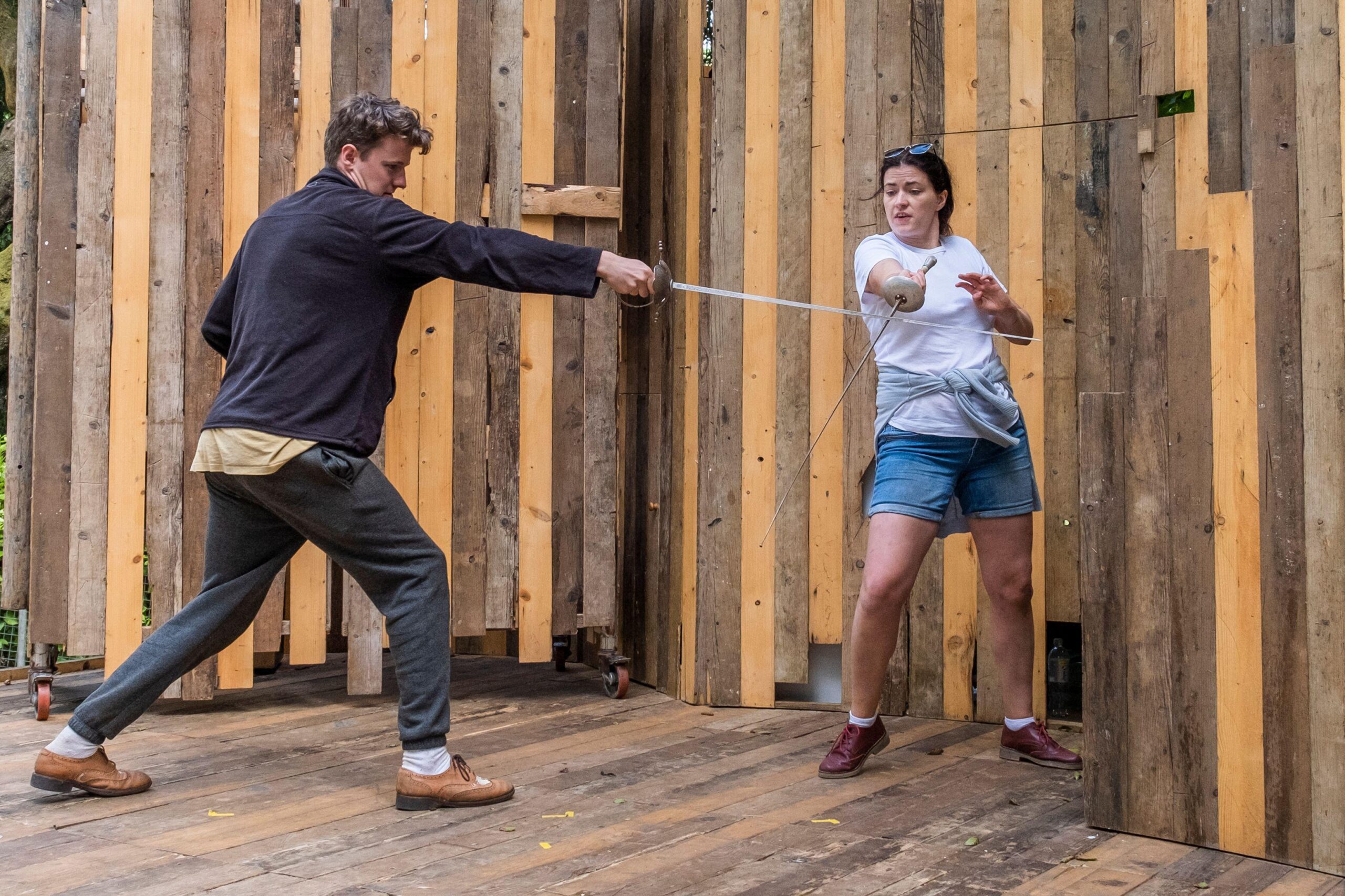
“But I already do martial arts, or dance, or other physical training – isn’t that enough?” Any physical training is a huge bonus as it means you already have a sense of movement, choreography and coordination. However, stage combat is different. It’s not about winning a real fight, but about creating the illusion of one. And it’s not like dancing in perfect unison either. You’re slightly out of sync, constantly responding and reacting to your partner. The challenge is making the fight look dangerous and convincing to the audience while keeping both actors completely safe.
Balancing acting and fighting at the same time is what makes stage combat such a unique skill. On stage, these skills are even more important because you’re performing the fight yourself. Even in film productions with the budget to hire stunt performers, actors are expected to perform the action.
How Your Stage Combat Training Impacts Fight Choreography
For stage productions, the fight director will come in for a limited number of rehearsals. Their role is to create choreography that tells a convincing story of violence while keeping everyone safe. But they won’t be performing it – it’s the actor’s role to learn the choreography and bring it to life. A fight director can’t magically transform an untrained actor into a convincing fighter overnight, so the choreography will be designed around the actor’s current skill level. The less experienced you are, the fewer ‘cool’ moves you’ll probably get to perform.
If you come to the production with little or no prior combat training, the fight director will have to compromise on the choreography – simplifying it to keep it safe and doable for the performers, while lowering the director’s expectations for how much storytelling the fight can carry. More and more UK theatre productions are now prioritising stage combat training and holding fight auditions. Casting highly skilled actor-combatants first in fight-heavy shows saves time and allows more exciting work within tight schedules.
For film, a stunt coordinator’s involvement in the casting depends on the production. They might recommend actors they know are strong in combat, and fight reels can help demonstrate your skill level, but keep in mind: you’re only as good as your last fight. Your current ability matters most, so a fight reel from years ago won’t carry much weight if you haven’t trained since.
Most of the time, stunt coordinators work with the cast they’re given. They may push for stunt doubles, editing solutions or additional training for actors, but all of this costs money, and on smaller productions, it might not even be an option.
No matter your level of training, be honest on set, in rehearsal and in your audition. If you have an injury or prefer not to do certain techniques, tell the fight director or stunt coordinator early so they can create choreography that allows you to perform confidently, this ensures the production runs smoothly and keeps you safe.
Stage Combat Technique vs Storytelling
Within stage combat training, there are specific techniques and concepts you will learn. However, it isn’t only about learning these concepts or how to perform punches, slaps or falls safely. It’s about telling the story of violence and making it believable and engaging. Connecting technical precision with emotional truth is extremely difficult. Once actors fully commit to a fight scene, their technique often falls apart – the body tenses and nuances are lost. Without proper and ongoing training, this frequently results in fights that either look fake or become unsafe.
If an actor is viciously punching a lifeless pillow in a self-tape for a fighting role (which might initially impress a casting director), it doesn’t mean they will be able to produce the same energy and truthfulness to deliver a punch that’s convincing, technically correct, fast and safe when another actor is in front of them.
A lack of stage combat experience often results in fights that are underpowered, clearly showing the choreography. Safety and choreography exist for the actors, not the audience. The audience pays to be impressed and fully immersed in the story. A strong actor-combatant can combine physical storytelling with character work, adapting the fighting style to the role they are playing (not all characters are martial artists!), while maintaining clarity and intention.
Building Connections and Partnerships Through Stage Combat
Focusing on my partner and connecting with them while doing fight scenes made me a better actor and it’s why I fell in love with stage combat. A lot of collaboration and negotiation goes on during rehearsals, building trust and working relationships. I always tell my students, “Sell your partner’s moves. Make them look good, and hopefully, they’ll do the same for you.”
If your scene partner performs an amazing action but you don’t truthfully react to it, it may make them look strange or weak. For example, in a recent action movie, a character was hit in the face with a heavy gun. There was a great illusion of contact and fantastic make-up showing a bruised nose, but their reaction was not as convincing as it could be. Being struck unexpectedly with a heavy object hurts. A lot! If you don’t fully sell that pain, the audience won’t buy the illusion.
Stage combat training teaches performers to be specific in their reactions, play pain accurately and coordinate everything with your partner.
Why Timing is Everything
While working on one TV series as an actor, I had a chat with a frustrated cast member who was struggling to get the timing right during a staged death. Dying convincingly can be tricky too – it takes practice, precision and the right timing.
They were supposed to react to an unexpected knife stab and fall. After a few takes that didn’t quite land, the director decided to use a stunt double to keep things moving smoothly. Later, in the green room, the actor admitted they’d never had stage combat training, which sparked a conversation about how essential good timing is in fights, acting and day-to-day life.
It’s not just about throwing a punch or stabbing someone, but knowing exactly when to act and when to react. Hitting cues precisely and mastering timing are key skills you’ll develop in stage combat training.
The Importance of Regular Practise
Stage combat won’t click overnight or after only a few classes. It needs time, repetition and consistency, like any other acting skill.
Sadly, it often happens that former students walk into fight auditions, proudly claiming they have an advanced qualification, but that was five years ago and they haven’t kept up their training since. It shows!
Keep your skills fresh. Regular, focused training makes a huge difference. With any physical skill, good practice builds strong habits and poor practice reinforces mistakes. When you take a stage combat workshop, or even do one-to-one training, having an experienced eye in the room means errors are corrected in the moment, helping you develop the right habits from the start.
Beyond skill-building, these workshops are a chance to meet like-minded people, work alongside experienced fight professionals, and (everybody’s favourite) network. But here, you don’t even have to talk. Your body, your work, your attention to detail – that’s your business card. Be present, take notes, be kind and you’ll leave an impression.
There’s another bonus: stage combat is a physical class. It’s cardio with a purpose – it improves stamina, helps you stay fit, and strengthens your body, all while building skills that can broaden your acting career.
Where to do Stage Combat Training
There are plenty of stage combat classes across the UK, from one-off workshops to full certification courses. I personally trained with the British Academy of Stage & Screen Combat (BASSC), and I can vouch for how thorough their training is. Kit Harington, Tom Hiddleston, Phoebe Waller-Bridge, Taron Egerton, Cynthia Erivo and Aimee Lou Wood took their Fight Performance Exam with BASSC. Their syllabus is taught at RADA and Royal Central School of Speech and Drama. The BASSC runs an annual two-week National Workshop, open to all levels, including beginners, where participants can train and complete their certification. You can also check out IDFight, which offers regular BASSC certification courses throughout the year.
The BASSC certificate includes 30 hours of training per weapon or discipline and concludes with a performance of a choreographed fight within the context of a scene, so you’ll act and you’ll fight. But the value of a certification course isn’t the certificate or your final grade – it’s the quality training hours where you begin developing your skills.
Look at courses near you and try a few different workshops to see which feels right: the training style, the teachers, the community and even the venue. If you have any questions or want a recommendation, feel free to drop me an email – I’m always happy to help.
Don’t wait for the fight director or stunt coordinator to train you after casting. Invest in your stage combat skills early and keep practising. It will expand your range, build real competence and, with it, genuine confidence, making you a far more attractive candidate for roles that demand physical storytelling.
I was lucky to be cast in Killing Eve. But the story is: after my first audition with Suzanne Crowley and Gilly Poole, I was initially offered a small role as one of the Prison Guards. During the audition, I also mentioned that I was highly trained in stage combat. Later, I received a call asking if I would audition for a larger role, which required fighting skills, even though the part had originally been written for a completely different casting type. I’m very grateful for the adaptability and openness of the casting team, but I do believe my combat training helped open that door.
Stage combat training isn’t just about fighting. It’s about acting – telling a story through movement, emotion, timing and connection with your partner – safely and convincingly. The audience may not consciously notice these details, but they absolutely feel when something is off. It takes a long time to develop such skills, so if you can, start training now. Performing a fight scene while acting is one of the most challenging things an actor will ever do, and training prepares you to do it with confidence and skill.
Keep training, keep fighting!
Actionable Insights:
- Focus on building foundational skills early. Production rehearsals are designed for specific choreography rather than long-term technical development.
- Prioritise consistent and regular practice to ensure your combat techniques remain safe and convincing enough to pass a professional fight audition.
- Communicate any injuries or physical limitations to the fight director early to ensure the choreography is safe and can be performed with confidence.
- View stage combat as a partnership. Your primary goal is to support your scene partner and react truthfully to maintain the illusion of danger.
- Seek out accredited certification courses and specialised workshops to build the stamina and technical precision required to handle complex physical storytelling.
Zhenya Leverett is a Certified Teacher with the British Academy of Stage & Screen Combat (BASSC) and teaches sword fighting and unarmed combat at RADA, The Royal Central School of Speech & Drama, Young Actors Theatre Islington, and IDFight. She has taught at The British National Stage Combat Workshop, the New York Summer Sling Stage Combat & Stunt Workshop and Lonestar Smash in Dallas.
As a fight director, Zhenya’s credits span opera, classical and modern theatre, with work on ‘Cinderella’ (English Touring Opera), ‘La Liberazione di Ruggiero’ (Longborough Festival Opera), ‘Ben Hur’ (Abbey Theatre), and productions of ‘King Lear’, ‘Macbeth’, and ‘Twelfth Night’ at RADA. As an actress, she is known for her role as Agniya in the BAFTA-winning TV series ‘Killing Eve’, where she traded punches with Jodie Comer.
Zhenya is the Creative Director at Acting Action Ltd. Her article “The Power of Teaching: Why Do You Want to Be A Stage Combat Teacher?” was recently featured in The Fight Master, the journal of the Society of American Fight Directors.
More information about Zhenya can be found on actingaction.com and bassc.org, and on Instagram @zhenyaleverett